PROGRAM
The programme includes keynote lectures, art–science tandem presentations, and parallel interactive workshops on art-science collaboration and science-policy interfaces. An accompanying exhibition and film screening will take place at ZHdK.
| 4th May 2026 — ZHdK, Toni-Areal, Zürich | |||
|---|---|---|---|
| Art-science exhibition | |||
| 17:00 | Kunstraum 5.K12 | Exhibition reception | • Works by students of ZHdK |
| Screening and panel discussion | |||
| 18:30 | Kino Toni | Phyto Futures. States of Planetary Being (26′) |
• Monica Ursina Jäger • Lena Bakker |
| Unfolding Waterscapes (10′) |
• Riikka Tauriainen • Marta Musso |
||
| 5th May 2026 — Eawag, Dübendorf | |||
| Keynotes | |||
| 9:30 | FC C20 | Networks: Art, science and communality – Marcus Maeder | • Marcus Maeder |
| Art Science Policy working on Common Ground | • Caterina Benincasa | ||
| Coffee break and exhibition | |||
| 10:30 | Forum Chriesbach Building Hallway | Cartoon exhibition: Competencies at the Science–Policy Interface | Cartoon |
| Tandem presentations – Moderated by Irène Hediger | |||
| 11:00 | Forum Chriesbach C20 | The One-Drop Cycle – A Fluid Boundaries Experience |
• Michael Azkoul (Dr Koul) • Nele Schuwirth |
| Instructions for the Field |
• Nadine Schütz • Artemis Treindl |
||
| Lunch break | |||
| Parallel interactive workshops | |||
| 13:00 | Forum Chriesbach C24 | Drawing out tensions: how cartoons can change Science–Policy dialogues | • Jialin Zhang • Sabine Hoffmann • Luisa Last • Martijn Sonnevelt |
| Forum Chriesbach D24 | Working with Futures Reflexivity in Art-Science-Policy Collaborations | • Eva-Maria Spreitzer | |
| Forum Chriesbach B81 | Sensing In Between | • Delphine Chapuis-Schmitz | |
| Coffee break and exhibition | |||
| 14:30 | Forum Chriesbach Building Hallway | Cartoon exhibition: Competencies at the Science–Policy Interface | Cartoon |
| Tandem presentations – Moderated by Benjamin Hofmann | |||
| 15:00 | FC C20 | Imagining Futures – between Speculative Design and High Performance Computing |
• Sophie Falkeis • Dirk Karger |
| Hydrorecord |
• Pauline Agustoni • David Janssen |
||
| Wrap up and closure | |||
| 16:00 | Response: Critical perspectives on art-science collaborations | • Yvonne Schmidt | |
| 16:30 | Apéro + open format | ||
Phyto Futures.
States of Planetary Being 2025
Monica Ursina Jäger in collaboration with Lena Bakker ETH Zürich
single-channel video installation (E), 4k, colour, sound, 26:16 min
ABSTRACT
What kind of landscapes evolve after the glaciers have retreated? Which organisms inhabit the new land and how do they transform the terrain? What are the delicate interactions and relationships between these living organisms and their environment? And most of all: what can we learn from these organisms and processes about resilience, hope, and life on a changing planet?
Phyto Futures. States of Planetary Being 2025 is a single-channel video installation based on the transdisciplinary research project with Lena Bakker, geobiologist ETH Zürich and the Centre for Origin and Prevalence of Life ETH Zürich. The Project is both an investigation into the altering natural environments and an exercise to explore transdisciplinary dialogue beyond established frameworks.
It looks at the challenges of the climate crisis from a new angle. While still mourning the loss of the glaciers the work looks beyond the crisis and discovers the new ecosystems that evolve in delicate post-glacial environments. Can we be sad and hopeful at the same time? What are the conditions in which more-than-human life can evolve, survive and thrive on a planet in transformation?
Phyto Futures. States of Planetary Being 2025 maps the multidirectional and more-than-human trajectories of life and non-life in postglacial landscapes both in Switzerland and arctic Svalbard.
Geobodies such as glaciers, rivers, fossil forests, microbes and sediments act as protagonists to navigate the complex entanglements between biological, mineral and temporal spheres.
The video work is narrated through biological and geological bodies along different states of planetary being: the drifting, the re-awakening, the buried, the dormant, the transient and the living.
BIO
Monica Ursina Jäger
Lena Bakker
Networks: Art, science and communality – Marcus Maeder
ABSTRACT
Marcus Maeder presents past and current projects at the intersection of science, art and society, and discusses their ecological, social and political impact. Maeder is an artist, researcher and composer. As an author, he has written on a range of topics in the fields of sound art, acoustic ecology, artistic research and digital media. Maeder studied Fine Art at Lucerne University of Applied Sciences and Arts (HSLU), Philosophy at the Open University of Hagen, and obtained his PhD in Environmental Systems Science at ETH Zurich. He has worked as an editor and producer for Swiss Radio SRF and as a researcher and lecturer at the Institute for Computer Music and Sound Technology (ICST) at Zurich University of the Arts (ZHdK). Maeder is a visiting researcher at the Swiss Federal Institute for Forest, Snow and Landscape Research (WSL) and a fellow researcher at the Free University of Berlin. Since September 2025, Marcus Maeder has been leading the ‘Knowledge to Society’ major within the Master’s programme in Art as a professor.
Art Science Policy working on Common Ground
ABSTRACT
In this talk I will introduce the work developed at the Joint Research Centre at the intersection of artistic inquiry, scientific research and EU policymaking. Specifically, we will discuss our latest project “NaturArchy” which aims to reimagine the relationship between human and non-human: how might we rethink our being in relation to nature, and engage with non-human scales, perspectives, and forms of knowledge?
After briefly contextualising how our art–science programme connects to EU policy, the talk explores how art–science–policy collaborations can open new ways of engaging with complex challenges, not only through outputs (such as artworks, papers, participatory workshops, presentations), but by reshaping — through deep collaborative and co-creative practices — how knowledge is generated, experienced, questioned and connected across disciplines and cultures. Through selected examples, the talk reflects on how these transdisciplinary approaches can foster innovative dialogue, catalyse alternative imaginaries and support more inclusive and forward-looking responses to socio-environmental transformations.
BIO
Caterina Benincasa is curator of the SciArt project at the European Commission’s Joint Research Centre. With a background in physics, philosophy, history of science, contemporary art, and heritage studies, she has spent two decades fostering art–science–heritage dialogues. At JRC, she develops opportunities for collaboration and co-creation between artists, scientists, and policymakers.
The One-Drop Cycle – A Fluid Boundaries Experience
Art-Science Tandem — Michael Azkoul (Dr Koul), Nele Schuwirth
ABSTRACT
What happens when a rapper, poet, martial arts instructor and massage therapist immerses himself into a water research institute embedded in the academic system? What happens when a senior scientist in the field of integrative ecological systems analysis immerses herself into hip hop culture, the martial arts called Systema, and philosophical discourse?
Transcending the fluid boundaries between arts and science, the personal and societal, the individual and systemic, the spiritual and political, rationality and mysticism, confidence and humility, principles and freedom. We will share thoughts and experience from the fluid boundaries program and our joined practices of improvisation and finding comfort in discomfort.
BIOS
Michael Jad Azkoul (Dr Koul) is a rapper, poet, author, martial arts instructor and massage therapist based in Geneva, Switzerland. His most important solo production was a book and album entitled Prophet of Doubt, which has been followed by various short projects, residencies, and collaborations. Hailing from an international background (Lebanese-American and Anglo-Uruguayan), he has always considered himself a freethinker, passionate about transdisciplinary approaches to what he perceives as universal themes. Sometimes political, sometimes philosophical, Dr Koul’s music combines “conscious” Hip Hop with jazz and traditional instrumentation, and he is most recognized as being one of the lead vocalists of Captains of the Imagination, a Geneva-based, English-speaking rap group.
Nele Schuwirth is a research group leader on Integrative Ecological Systems Analysis and head of the department Systems Analysis, Integrated Assessment and Modelling (SIAM). Her group works on inter- and transdisciplinary projects in the fields of ecological modelling, decision support and ecological assessment of freshwater ecosystems.
Second Series of Cartoons:
Competencies at the Science–Policy Interface
ABSTRACT
Bringing together actors from science and policy is crucial for addressing today’s pressing challenges — from climate change to biodiversity loss and social inequities. But effective dialogue at the Science–Policy Interface (SPI) requires more than knowledge. It takes a set of competencies that are often invisible: listening carefully, recognizing diverse roles, navigating complexity, engaging at the right time and in the right place.
This second series of cartoons illustrates these competencies in a playful yet thought-provoking way. Each scene highlights what it takes to collaborate meaningfully across different worlds, sparking recognition, reflection, and maybe a smile.
BACKGROUND
This second series of cartoons was developed from the Competencies Framework for the Science–Policy Interface (Dettwiler, D., Salomon, H., Piessens-Siegrist, M., Last, L., Zhang, J. & Hoffmann, S., in review). The framework identifies four key competencies essential for meaningful engagement: cognitive, spatial-temporal, relational, and reflexive competencies. These competencies enable actors from science, policy, and practice to navigate complexity, choose the right time and place for dialogue, build trust and networks, and reflect on their own roles and power dynamics.
The cartoons bring these dimensions to life in playful but thought-provoking scenes. They illustrate challenges such as navigating wicked problems, tailoring communication, identifying power dynamics, and reflecting on one’s role.
BIOS
Jialin Zhang is a Postdoctoral Researcher at Eawag, working in the Inter- and Transdisciplinary (ITD) Research Group within the Department of Environmental Social Sciences.
Sabine Hoffmann is Group Leader of the Inter- and Transdisciplinary (ITD) Research Group at Eawag within the Department of Environmental Social Sciences.
Instructions for the Field
Beyond communication: How art–science collaborations reframe questions for science, society, and policy
Art-Science Tandem — Artemis Treindl, Nadine Schütz
ABSTRACT
Fungi are ubiquitous but cryptic creatures, huge and yet microscopic substrate-dwelling networks that only occasionally peak above ground. How do we collect data on a largely hidden diversity in a highly structured and constantly changing environment? Which methods and tools are mobilized to strive for objectivity in this process? Which story do we tell, which language do we use to communicate our observations and what remains unsaid?
This art–science tandem brings together mycologist Artemis Treindl and curatorial researcher and art educator Nadine Schütz, who met during an Art–Science Residency at WSL Birmensdorf organized by the artists-in-labs program (ZHdK) in 2023. Over several months of shared fieldwork, they collaborated within the scientific research project “Revision of the Red List of Endangered Macrofungi in Switzerland”.
Drawing on Nadine’s master thesis and curatorial research into mycological data production and Artemis’s scientific field practice, the talk presents exercises, anecdotes, and perceptions from joint fieldwork to examine how observational data is generated in practice. In landscapes where fungi appear and disappear, where weather shifts, bodies move and time presses, the speakers reflect on how sampling protocols, classification schemes, time constraints, and observational routines shape what is recorded and what remains invisible. By comparing scientific and curatorial perspectives on the same field situations, the talk reflects on how disciplinary training influences perception, decision-making, and interpretation, and how fungal “facts” emerge through situated, collaborative, and method-driven processes rather than as objective representations of nature.
BIOS
Dr. Artemis Treindl is a mycologist specializing in fungal diversity and conservation. At the National Data Center SwissFungi (WSL), she conducted large-scale, national monitoring of fungal diversity in Switzerland for the revision of the Swiss Red List of macrofungi. Today, she is Curator of the Fungarium, the mycological collection of ETH Zurich, where she studies archived and contemporary fungal biodiversity, systematics, and the ecological roles of fungi in a changing environment.
Nadine Schütz works at the intersection of art education, curatorial research, and graphic design with a focus on art–science practices. Since 2020, she has been involved in projects with cultural and scientific institutions including the Ars Electronica Festival, Mediamatic Amsterdam, and WSL Birmensdorf (artists-in-labs program). She holds a Master’s degree in Curatorial Studies (ZHdK). Her master’s research examines how mycological data is produced in the field by tracing instructions as they are enacted through the researcher’s actions and thereby questions the notion of scientific objectivity. Currently, she works as an Artistic Assistant in the Minor Material: Biological Co-Creation at ZHdK.
Drawing out tensions: how cartoons can change Science–Policy dialogues
ORGANIZERS
Jialin Zhang, Sabine Hoffmann, Luisa Last, Martijn Sonnevelt
ABSTRACT
Science–policy dialogues often struggle to address complexity, uncertainty, and conflicting values. These challenges become especially visible in the context of climate change, biodiversity loss, and energy transition. Cartoons, as a form of artistic intervention, offer an unexpected but effective way to make such tensions visible. They can also spark reflection and dialogue.
Using the “Second Series of Cartoons: Competencies at the Science–Policy Interface,” developed by Eawag, Zurich-Basel Plant Science Center (PSC) and World Food System Center (WFSC), this workshop will explore how visual storytelling can translate abstract competencies into relatable images, while helping to reveal blind spots, question assumptions, and highlight emotional or ethical dimensions that technical reports often overlook.
Participants will engage with selected cartoons that illustrate vital yet often abstract competencies: relational trust, navigating uncertainty, timing and spatial awareness, reflexivity, systems-thinking, and communication across domains. Through these examples, we will examine how cartoons function as “boundary objects” that both connect and challenge different stakeholders by offering shared reference points that are less hierarchical and more playful.
In interactive group exercises, participants will reflect on their own experience of tensions in real science–policy dialogues and experiment with designing quick cartoon concepts. The goal is not to produce polished artwork, but to explore how visual prompts can reframe a discussion, surface neglected perspectives, or open space for constructive disagreement.
The workshop concludes with a collective reflection and the formulation of key questions to share with the broader symposium community.
BIOS
Jialin Zhang is a Postdoctoral Researcher at Eawag, working in the Inter- and Transdisciplinary (ITD) Research Group within the Department of Environmental Social Sciences.
Sabine Hoffmann is Group Leader of the Inter- and Transdisciplinary (ITD) Research Group at Eawag within the Department of Environmental Social Sciences.
Luisa Last is the Program Coordinator for the Zurich-Basel Plant Science Center’s PhD Program in Science and Policy (ETH Zurich, UZH and University of Basel), and an Educational Expert.
Martijn Sonnevelt is Lecturer at the Department of Environmental Systems Science of ETH Zurich and Executive Director at the World Food System Center of ETH Zurich.
Working with Futures Reflexivity in Art-Science-Policy Collaborations
ABSTRACT
Art–science-policy collaborations are gaining traction as a powerful mode of inquiry for addressing complex challenges in new ways within and beyond the realm of research. As such, these collaborations facilitate learning across epistemic cultures and enable new forms of sense-making, experimentation, and knowledge communication that can transgress disciplinary boundaries towards transformative change.
Yet, this potential is not automatically given: while art–science practices can forge new pathways and avenues of insight, knowledge creation, and implementation, they also hold the risk to make disciplinary perspectives even more rigid and entrenched by reproducing dominant assumptions about what counts as legitimate, useful, and effective from the different points of view.
This workshop introduces futures reflexivity as a methodological framework for engaging these tensions more consciously and generatively, and offers a concrete exercise on how to start cultivating futures reflexivity as an important enabling factor for the desired outcomes of transformative learning and change within art-science-policy collaborations.
Through a short embodied exercise and structured reflection prompts, participants will experience and explore: (1) how existing anticipatory assumptions shape our perspectives, (2) how aesthetic practices can make such assumptions tangible and discussable, and (3) how cultivating futures reflexivity can therefore support transformative learning and change in and through art–science-policy collaborations. Participants will leave with a practical understanding of this enabling capability and new facilitation impulses for integrating futures reflexivity into their own transdisciplinary work.
BIO
Eva-Maria Spreitzer is a Zurich-based PhD candidate in Organization and Cultural Studies (Leuphana University Lüneburg), a research fellow at ZHdK, and a practitioner–researcher working at the intersection of futures, transdisciplinary collaboration, and arts-based inquiry. Her research explores how futures can be engaged as relational and transformative processes beyond prediction, planning, or speculation, with a focus on the role and effects of futures reflexivity, transformative learning, and aesthetic practices. She collaborates with partners across academia, design, and cultural institutions, and designs workshops and experimental formats that aim to enable new approaches to knowledge creation and dissemination.
Sensing In Between
ABSTRACT
In the short story “The Author of the Acacia Seeds” (1974), poet and writer Ursula Le Guin speculates on new domains of science whose task would be to translate the language of ants and penguins, the transient lyrics of lichens, and the poetry of rocks. This requires radical shifts beyond established frames and categories: the therolinguist and phytolinguist need to “rethink the very elements of (their) science,” as well as their understanding of language.
Based on this speculation, Sensing In Between confronts the question: How can we sense beyond an anthropocentric perspective? As the word sense refers both to sensory abilities and to the ability to make sense, the practice of sensing combines aesthetic and semantic dimensions. Dwelling on this ambivalence, the workshop proposes exploring ways of making sense that emerge from in-betweenness and foreground hybridity rather than pre-given categories.
Designed as an iterative sequence alternating between individual and collective constellations, the workshop will take place outdoors. It invites participants to move beyond habitual patterns of observation, to explore shifts in sensing and attention, and to experiment with languaging as a practice shaped by the situated entanglements of which we, as humans, are part.
BIO
Delphine Chapuis Schmitz (F/CH) is an artist, writer, and researcher trained in philosophy and visual arts. Her process-based practice explores the poïetic potential of language(s) through thinking-in-the-making, unfolding across writing, installations, and lecture performances within collective and cross-disciplinary constellations. Engaging a creative-critical approach, she investigates processes of (un)making sense and the interplay between bodying and languaging. She teaches at the Zurich University of the Arts, Department of Cultural Analysis, and holds a PhD in Philosophy from the University Paris 1 Panthéon-Sorbonne. She co-founded DEARS, a platform for cross-disciplinary writing practices, and is part of WITHING, a durational project in language-based artistic research.
www.dchapuis-schmitz.com
Imagining Futures – between Speculative Design and High Performance Computing
ABSTRACT
As climate change grows increasingly complex, cutting across sectors and affecting every field, the need for interdisciplinary collaboration is more critical than ever. In a world marked by multiple, intersecting crises, new hybrid formats of imagining possible futures are needed. ECHOES brings together design and climate science to reframe complex climate questions, combining imagination with data-driven inquiry to explore futures in “high resolution”.
The project integrates downscaled climate simulations with “cascading-effects storytelling” (Falkeis 2021), creating a hybrid methodology that links scientific modeling and hypothesis generation with scenario building, speculative design and world-building. Funded by the Swiss National Science Foundation, ECHOES investigates the ripple effects of megadroughts in the water towers of Europe and traces their repercussions across ecological, geopolitical and socio-economical dimensions.
Using multi-model climate data processed through high-performance computing, the project generates high-resolution simulations (CHELSA downscaling, Karger) that form the foundation for exploring possible impacts and imagining alternative futures. Providing detailed, localized insights, these data points mark the cornerstones of each scenario before the narrative links them together with a “red thread”. These visual narratives reveal connections across climatic, ecological, social and political systems. By combining speculation with storytelling, the project highlights the multiplicity of futures, emphasizing that futures are neither singular nor predetermined.
Speculative design fuels the process by asking “what if?” and imagining alternative pathways. It works relationally, examining and reshaping connections between social, technological, and environmental systems, provoking debate, raising questions, and positioning the public as active participants in shaping the future.
Spatially, the project unfolds through an immersive exhibition and multi-channel video installation. This format allows complex, multi-layered narratives to be experienced in visceral and sensory ways, facilitating emotional and embodied forms of knowledge production that go beyond communication and reframe how climate futures can be sensed, discussed, and acted upon.
echoesechoes.ch
BIOS
Sophie Falkeis is a Vienna- and Zurich-based designer exploring socio-ecological and geopolitical complexities of climate change through imagining possible futures through Speculative Design. Her work is part of the MAK permanent collection and has been exhibited in London, Vienna, Eindhoven, Almere, Beijing, Bern, Berlin, Copenhagen and Gothenburg and was featured in the New York Times. Alongside her independent practice, Sophie currently acts as Co-Pi of the project ECHOES at the Swiss Federal Research Institute WSL, ETH-Domain, funded by the SNF.
sophiefalkeis.com
Dirk Karger is a senior researcher at the interface of macroecology, biodiversity research, and climatology at the Swiss Federal Institute for Forest, Snow and Landscape Research WSL. His research focuses on how climate and biodiversity are linked in time and space. A focus of his recent work has been the development of algorithms to downscale climate data to the biologically relevant scales needed for ecological studies. He is currently studying how extreme weather and extreme events, such as megadroughts, affect vegetation and biodiversity. He has also done extensive work on the geography and biodiversity of cloud forest ecosystems in the tropics and the biogeography of tropical islands.
Hydrorecord
ABSTRACT
Collaborating on their common project Hydrorecord in the context of art and science programme PolARTS by Pro Helvetia and Swiss Polar Institute, Pauline Agustoni and Dave Janssen form a tandem interested in the role that art and science can jointly play in understanding water chemistry holistically. Interested in fieldwork aesthetics and tool design, their research revolved around working with several augmented scientific devices to generate ambiguous and artistic visual material that offers a new perspective on water research.
Focusing their research on networks of glacial lakes in Switzerland and Southern Greenland, their experimental project revolved around the understanding of scientific and artistic processes, tools, technologies and gestures, to reflect on the role they can play in understanding complex waterscapes.
BIOS
Pauline Agustoni is a Swiss designer and artist based in Berlin. Her work explores the poetry of encounters between materials, production techniques, and gestures of making. Through her projects, be them scenographies, publications or series of objects, she encourages a heightened awareness of the gestures and techniques that shape our material world.
David Janssen is a research group leader at Eawag. His research in aquatic geochemistry focuses on trace elements as nutrients, toxins, and tracers of biogeochemical processes. His research group uses a combination of field and lab techniques, and often works in collaboration with physicists, ecologists, and microbiologists.
EXHIBITION
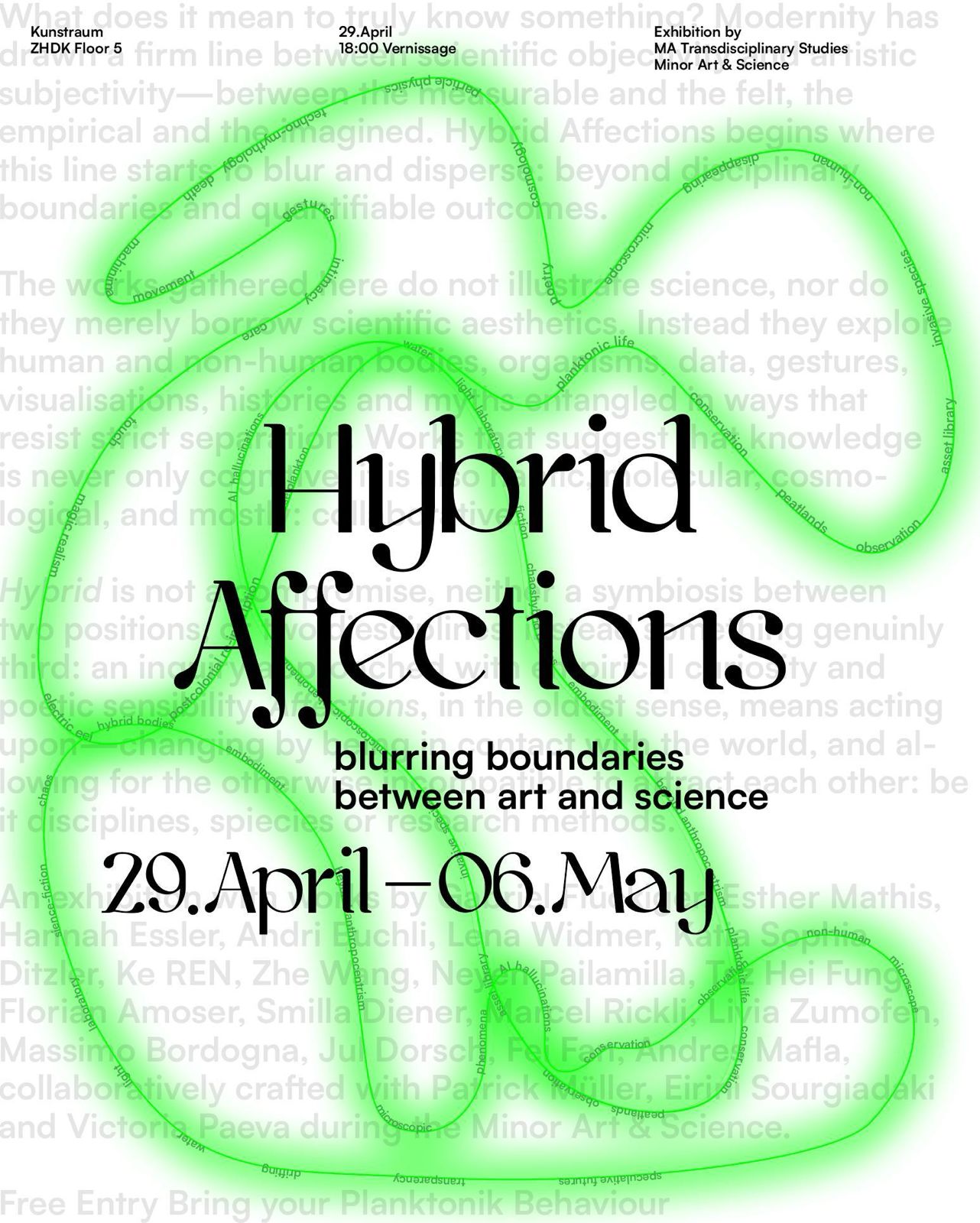
Hybrid Affections
Opening: 29 April 2026, 17:00
Exhibition: 30 April – 6 May 2026
Location: Kunstraum 5.K12, ZHdK Toni-Areal
→ To see more about the exhibition
What does it mean to truly know something? Modernity has drawn a firm line between scientific objectivity and artistic subjectivity—between the measurable and the felt, the empirical and the imagined. Hybrid Affections begins where this line starts to blur and disperse: beyond disciplinary boundaries and quantifiable outcomes. The works gathered here do not illustrate science, nor do they merely borrow scientific aesthetics. Instead they explore human and non-human bodies, organisms, data, gestures, visualisations, histories and myths entangled in ways that resist strict separation. Works that suggest that knowledge is never only cognitive: it is also haptic, molecular, cosmological, and mostly: collaborative. Hybrid, is not a compromise, neither a symbiosis between two positions, or two diesciplines, instead something genuinely third: an inquiry approached with empirical curiosity and poetic sensibility. Affections, in the oldest sense, means acting upon—changing by being in contact with the world, and allowing for the otherwise incompatible to attract each other: be it disciplines, spiecies or research methods.
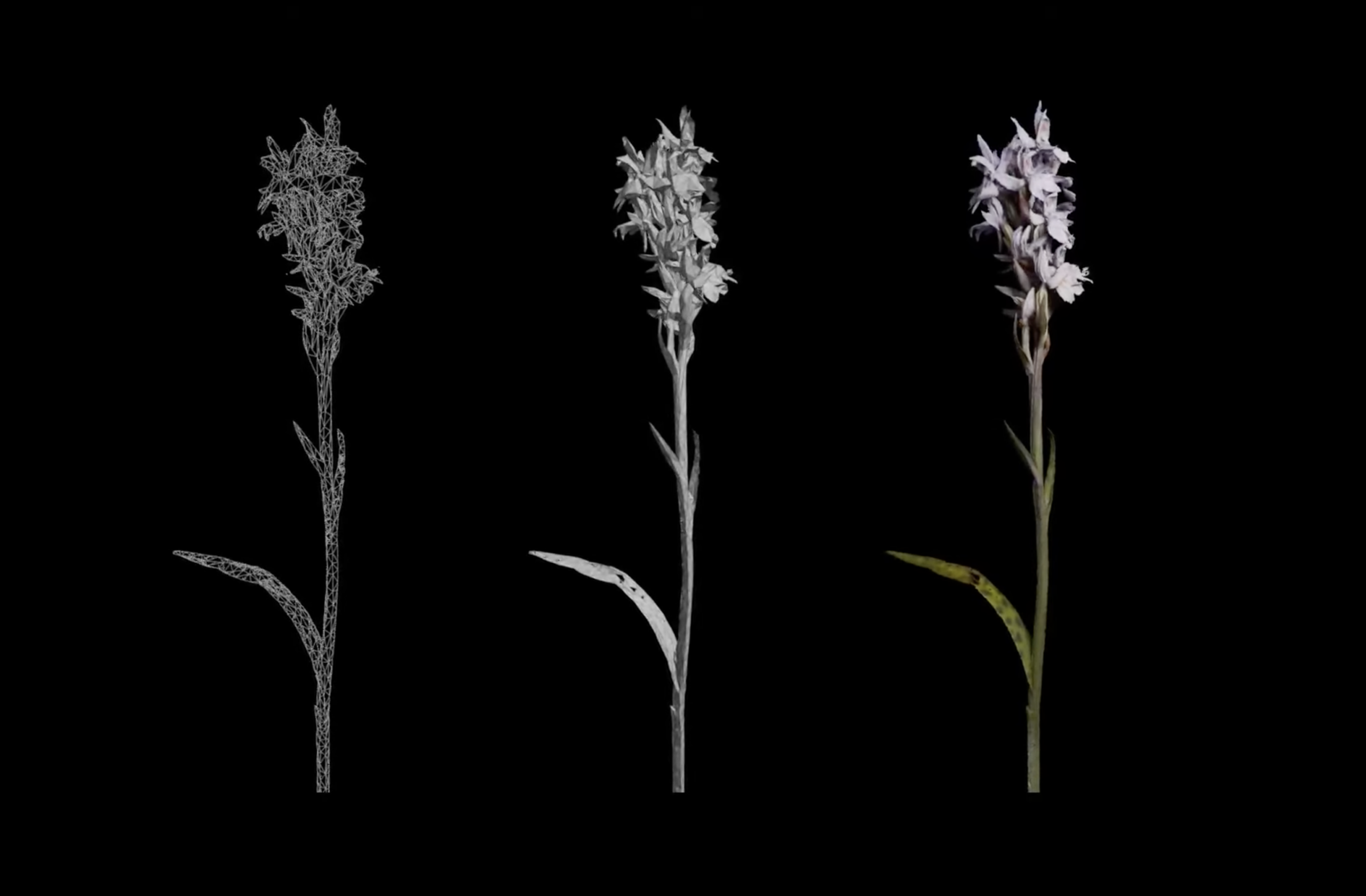
Beyond Communication
Exhibition: 4 May – 13 May 2026
Location: Forum Chriesbach Main Hall
→ To see more about the exhibition
In recent years, the connection between art and science has gained new momentum: transdisciplinary research, artistic fieldwork in laboratories, ecological projects, and data-driven aesthetics are increasingly shaping both artistic and scientific practices. It is no longer merely a matter of art responding to or communicating scientific knowledge, but of the joint development of questions, methods, and forms of knowing—especially against the backdrop of rapid socio-ecological change. Questions about how we want to live, what values shape our planetary coexistence, and what transformations are necessary are being posed anew. What is needed today is not only rational scientific insight, but above all speculative thinking and the imagination of future visions and what-if scenarios that can provoke societal transformation. This growing field—situated between experimental research, aesthetic experience, and social reflection—also gives rise to new forms of presentation, discussion, and convergence. Within the Master’s program in Transdisciplinary Studies at Zurich University of the Arts, a variety of collaborative projects have emerged in recent years, bringing together artistic, social, and scientific forms of knowledge and practice. These include, for instance, the case studies on the UNESCO Biosphere Entlebuch conducted together with the Td-Lab at ETH Zurich; project weeks with the Alpine Research and Education Station Furka; collaborations with the mLab of the Institute of Geography of the University of Berne, the Water Research Institute EAWAG of ETH, or the Digital Society Initiative of the University of Zurich; as well as student participation in the Artist-in-Labs program, among others. These collaborations have resulted in numerous works, some of which remain in a sketch phase, while others have developed a more autonomous character or even evolved into master’s projects. The exhibition in the Kunstraum of ZHdK’s campus Toni-Areal will give some insights in these practices.
SCREENINGS
In cooperation with the interdisciplinary lecture series KEIN KINO
Phyto Futures. States of Planetary Being (2025)
Monica Ursina Jäger in collaboration with Lena Bakker, ETH Zürich
single-channel video installation, 4k, colour, sound, 26:16 min
What kind of landscapes evolve after the glaciers have retreated? Which organisms inhabit the new land and how do they transform the terrain? What are the delicate interactions and relationships between these living organisms and their environment? And most of all: what can we learn from these organisms and processes about resilience, hope, and life on a changing planet?
Phyto Futures. States of Planetary Being is a single-channel video installation based on the transdisciplinary research project with Lena Bakker, geobiologist ETH Zürich and the Centre for Origin and Prevalence of Life ETH Zürich. It looks at the challenges of the climate crisis from a new angle. While still mourning the loss of the glaciers we look beyond the crisis and discover the new ecosystems that evolve in these delicate post-glacial environments. Can we be sad and hopeful at the same time? What are the conditions in which more-than-human life can evolve, survive and thrive on a planet in transformation? Phyto Futures. States of Planetary Being is both an investigation into the altering natural environments and an exercise to explore transdisciplinary dialogue beyond established frameworks.
Credits
Concept and Script: Monica Ursina Jäger in collaboration with Lena Bakker, ETH Zürich
Voice: Lea Whitcher
Composition and Sound: Michael Bucher
Camera and Editing: Monica Ursina Jäger, Myrien Barth and Michael Zogg
Text: Monica Ursina Jäger and Damian Christinger
With generous support: Pro Helvetia Swiss Arts Council, ETH Zürich, FONDATION SUISA, Ernst und Olga Gubler-Hablützel Stiftung, Bergen Assembly
Artist Monica Ursina Jäger has established an artistic practise at the intersection of art and ecology. Exploring different forms of art-science collaborations is at the core of her practise. Her latest long-term art project Liquid Territory was an exploration of the possibilities that arise when an artist thinks like a geologist and works from a poly-temporal perspective to examine geological and conceptual processes of erosion and sedimentation.
www.muj.ch
Geobiologist Lena Bakker is a doctoral student currently working on better understanding the role of soil microorganisms in a greening Arctic. She is working in the context of a multidisciplinary team of scientists that are trying to elucidate the mechanisms of Arctic greening from many different perspectives. The study of these microorganisms at the interfaces between the bedrock, the organic soil, plants and the atmospheres, is crucial in order to better describe this dramatically changing ecosystem. The motivation behind her science is deeply rooted in the fascination for the diversity, complexity and drivers of life and the many facets in which it interacts with its surroundings.
geobiology.ethz.ch
Unfolding Waterscapes (2025)
Riikka Tauriainen & Marta Musso
10 min
An art–science collaboration exploring aquatic ecosystems from human and non-human perspectives, presenting water as an active medium of memory, transmission, and ecological knowledge.
Unfolding Waterscape is an exploration of the interconnectedness of water, combining insights from scientific research and visual art. Created through a collaboration between plankton researcher Marta Musso and visual artist Riikka Tauriainen, the film offers an evocative portrait of underwater life.
Structured around two interwoven perspectives, the first movement presents aquatic environments from a non-human point of view, submerged in river currents, drifting through jellyfish blooms, and diving into microscopic worlds. The second perspective shifts toward the collaborative process between scientist and artist. Revisiting the same watery sites, it foregrounds the social dimensions of fieldwork, dialogue, and shared exploration.
Together, these perspectives offer a layered reflection on water as a medium of transmission, memory, and archive. Water emerges as an active participant, shaping, storing, and circulating ecological, geological, and social processes. Through this dual viewpoint, Unfolding Waterscape invites viewers to reconsider how knowledge is formed and shared across disciplines and scales.
Marta Musso (she/her) is a marine biologist, illustrator, and sailor focused on ocean literacy and science communication. Her work centres on plankton ecology and the microcosms of ocean drifters. She develops educational materials and participatory workshops, often in collaboration with artists and youth, to highlight the role of plankton in marine ecosystems and climate regulation. She studies and works at the Danish Technical University, DTU Aqua in Copenhagen.
Instagram: _possea
Riikka Tauriainen (she/they) is a visual artist and researcher whose installations, films, and sculptures explore ecology, oceanic literacy, and gender politics. Working between art and science, she investigates water phenomena and material kinships through feminist and posthumanist lenses. She is a doctoral candidate at the University of Bern and researcher at EcoArtLab, Bern Academy of the Arts. Based in Zurich, she holds an MFA from Zurich University of the Arts.
Instagram: riiriitauriainen
www.riikkatauriainen.net